
In brief
Delhi's air quality has worsened to "very poor" and "severe" categories, exacerbated by factors like Diwali firecrackers and crop burning. Pollution levels surpassed WHO limits, leading to government action such as a ban on fireworks and restrictions on construction activities.
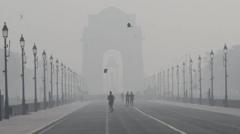
The air quality in Delhi has taken a grim turn as pollution levels recently escalated to "very poor" and "severe" categories, alarming health officials and residents alike. Data shows that pollutant levels surged as much as 25-30 times beyond the World Health Organization's (WHO) recommended safety thresholds at multiple sites across the city last week. With festivities like Diwali approaching, experts warn that stagnant weather conditions and the traditional burning of agricultural waste from nearby states will likely exacerbate the problem.Between October and January, Delhi and several other northern cities in India consistently experience a spike in air pollution levels. During this annual crisis, schools, businesses, and public offices often close down to mitigate health hazards. Recent data from the government-run Safar website noted that the concentration of tiny particulate matter (PM 2.5)—particles that can severely impact lung health—reached alarming highs of 350 micrograms per cubic meter. The air quality is categorized as "very poor" when PM 2.5 levels hover between 300 to 400, and "severe" when they exceed 400.As winter approaches, Delhi finds itself blanketed by smog due to factors such as vehicular emissions, smoke from crop residue burning, and dust. Farmers in the neighboring states of Punjab and Haryana frequently resort to burning stubble to clear their fields, a process that contributes significantly to Delhi's pollution. Despite requests for financial and technical assistance to adopt cleaner practices, effective government responses remain elusive.Ahead of the Diwali festival, the Delhi government has implemented a total ban on the manufacture, sale, and storage of firecrackers. However, past efforts to enforce such bans have often fallen short, as many residents acquire fireworks through unofficial channels. Additionally, the government has activated its Graded Response Action Plan (GRAP), which includes prohibiting coal and firewood-related activities and restricting diesel generator use for non-essential services.As the situation worsens, authorities have strongly advised residents to limit outdoor activities and rely more on public transport to minimize emissions from vehicles. Measures to control dust through water sprinkling on roads have also been deployed. With air quality concerns escalating, the future looks challenging for the health and well-being of Delhi's population.
