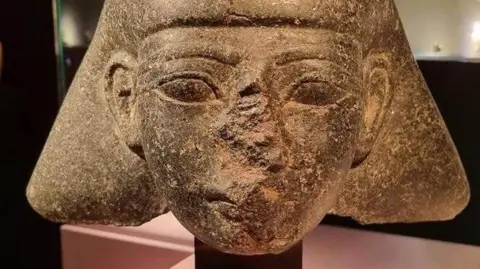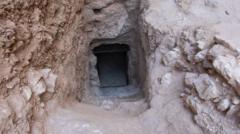
Two hours ago, a British archaeological team led by Dr. Piers Litherland has revealed the potential discovery of a second tomb belonging to Pharaoh Thutmose II in Egypt, just days after announcing the unearthing of the first tomb of a pharaoh since the legendary Tutankhamun's tomb was discovered over a century ago. Dr. Litherland expressed his belief that this newly uncovered site could contain the mummified remains of Thutmose II.
Current theories suggest that the initial tomb was evacuated merely six years following Thutmose II's burial due to flooding, prompting the relocation of the significant artifacts and the mummified body to a second tomb. Dr. Litherland suspects that this second resting place is buried beneath a 23-metre (75 ft) mound of limestone, ash, rubble, and mud plaster, artfully created by ancient Egyptians to mimic the natural landscape of the Western Valleys within the Theban Necropolis, located near Luxor.
The discovery of the first tomb, which had been found hidden behind a waterfall, unveiled a burial chamber adorned with exquisite decorations indicative of a pharaoh's resting place. A significant posthumous inscription discovered during the search implied that the contents of Thutmose II's tomb may have been transferred to a nearby location by his wife and half-sister, the notable Queen Hatshepsut.
While the British-Egyptian team has begun their excavation efforts by hand—deemed necessary after tunneling was deemed unsafe—they hope to unearth the second tomb within a month. The findings in the original tomb revealed a surviving blue-painted ceiling adorned with yellow stars, a hallmark of royal burials. Dr. Litherland shared his astonishment as he described the moment of discovery, expressing the emotional weight that comes with encountering such unexpected archaeological wonders.
Thutmose II, often recognized for his association with Queen Hatshepsut, is an ancestor of the celebrated Tutankhamun, whose tomb was famously unearthed by British archaeologists in 1922. The ongoing explorations reflect a vibrant period of discovery within the ancient Egyptian landscape, further enriching historical knowledge of this renowned civilization.
Current theories suggest that the initial tomb was evacuated merely six years following Thutmose II's burial due to flooding, prompting the relocation of the significant artifacts and the mummified body to a second tomb. Dr. Litherland suspects that this second resting place is buried beneath a 23-metre (75 ft) mound of limestone, ash, rubble, and mud plaster, artfully created by ancient Egyptians to mimic the natural landscape of the Western Valleys within the Theban Necropolis, located near Luxor.
The discovery of the first tomb, which had been found hidden behind a waterfall, unveiled a burial chamber adorned with exquisite decorations indicative of a pharaoh's resting place. A significant posthumous inscription discovered during the search implied that the contents of Thutmose II's tomb may have been transferred to a nearby location by his wife and half-sister, the notable Queen Hatshepsut.
While the British-Egyptian team has begun their excavation efforts by hand—deemed necessary after tunneling was deemed unsafe—they hope to unearth the second tomb within a month. The findings in the original tomb revealed a surviving blue-painted ceiling adorned with yellow stars, a hallmark of royal burials. Dr. Litherland shared his astonishment as he described the moment of discovery, expressing the emotional weight that comes with encountering such unexpected archaeological wonders.
Thutmose II, often recognized for his association with Queen Hatshepsut, is an ancestor of the celebrated Tutankhamun, whose tomb was famously unearthed by British archaeologists in 1922. The ongoing explorations reflect a vibrant period of discovery within the ancient Egyptian landscape, further enriching historical knowledge of this renowned civilization.