In brief
In the face of frequent internet outages, the Léon Thévenin plays a vital role in safeguarding communication across Africa, with a dedicated crew ensuring connectivity.
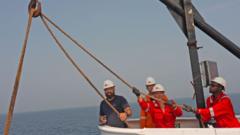
The article text: A ship the size of a football field, crewed by over 50 engineers and technicians, is cruising the oceans around Africa to maintain the continent's internet connectivity. This remarkable vessel, known as the Léon Thévenin, provides an essential service, especially highlighted during last year's widespread internet blackouts caused by damage to undersea cables.When cables buried under the ocean were severed, millions of people from cities like Lagos to Nairobi found themselves in digital darkness: messaging applications failed and banking transactions plummeted, leaving individuals and businesses struggling to function. Over the past 13 years, the Léon Thévenin has specialized in repairing these underwater cables. "I keep countries connected," states Shuru Arendse, a cable jointer from South Africa who has spent more than a decade aboard the ship. His pride reflects that of the entire crew on the Léon Thévenin, which stands eight stories high and is equipped with an array of specialized tools.A module of interconnected computers and servers make up the internet, often relying on over 600 fiber optic cables worldwide to transfer data to users. Most of these servers are based in data centers outside of Africa, while fiber optic cables stretch along the ocean floor, linking the continent's coastal cities to those data centers. "As long as the servers aren't in the country, you need a connection between them through cables," explains Benjamin Smith, the ship's deputy chief mission officer.These undersea cables are intended to last 25 years with minimal upkeep. However, they frequently suffer damage due to human activities. "Cables don't typically break on their own unless they're in areas with high currents or sharp rocks," notes Charles Heald, who oversees the ship's remotely operated vehicle (ROV). Unfortunately, it is commonly a result of ships anchoring incorrectly or trawlers scraping the seabed. Natural disasters and extreme weather can also be culprits, especially, for instance, in the Congo Canyon.Last year, three vital cables in the Red Sea were hampered by an anchor from a ship, impacting connectivity for millions in East Africa. Following that, separate breakages in multiple cables along the West African coast caused severe outages in Nigeria and beyond. Cable issues can stretch for weeks, disrupting online services significantly.Problems with connectivity are generally identified through signal strength checks transmitted along the cables. Local teams may handle minor faults in shallow waters, but for deeper repairs exceeding 50 meters, the Léon Thévenin is called into action to repair cables at depths of up to 5,000 meters. Repair missions require tactical coordination, and the complexity depends on the specific fault. If a fiber break occurs in the core, the data cannot travel and requires transmission through an alternate cable. Sometimes, damage affects only the cable's protective layers, allowing for reduced efficiency. To locate faults, a light signal is sent through the cable, which helps pinpoint breaks. ROVs are then deployed to retrieve and fix the damaged sections. Each mission, like the one witnessed by the BBC off Ghana, can take over a week, but most users remain unaware due to traffic rerouting.Upon receiving alerts of damaged cables, the Léon Thévenin crew can respond within 24 hours, contingent on various factors like location and bureaucratic timelines. "Sometimes permits can prolong our stay offshore," says mission chief Loic Wallerand. Annually, the crew spends around six months at sea, a commitment that often comes with personal sacrifices.The crew's backgrounds are diverse – from French and Filipino to South African and Malagasy. As they navigate tasks aboard, personal stories emerge. Some members, like chief steward Adrian Morgan, express the emotional toll of extended absences. Others, like chief cook Remario Smith, share tales of life changes that led them to the sea, recognizing their role in connecting Africa to the global network.Despite challenges, there is camaraderie and shared purpose among the crew. "We are the link between Africa and the world," says chief engineer Ferron Hartzenberg, solidifying the Léon Thévenin's legacy as a crucial lifeline for internet connectivity across the continent.