
In brief
The US stock market experienced sharp swings on Monday as investors hoped for a shift from tariffs to trade deals despite President Trump's escalated threats against China. The S&P 500 ended slightly down, marking significant losses over recent days, echoing fears of an impending trade war and recession.
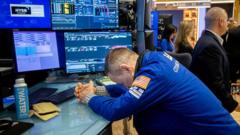
The US stock market witnessed significant volatility on Monday, with shares attempting to recover as investors speculated whether President Donald Trump would pivot from imposing tariffs to establishing trade agreements. The S&P 500 index, which reflects the performance of 500 prominent US companies, ended the day down approximately 0.2%, following a day characterized by drastic fluctuations reminiscent of the market turbulence during the Covid-19 pandemic. This relative stabilization occurred amid Trump intensifying his tariff rhetoric against China, while US Treasury Secretary Scott Bessent indicated ongoing negotiations with Japan and other countries.Trump's mixed messages included predictions that some of the tariffs would remain indefinite while others might be subject to negotiation. He dismissed calls to postpone the recently announced import taxes applicable to all countries, leading to concern among investors, particularly as more than 50 countries have reportedly expressed interest in discussing trade issues with the White House. European Union trade representative Maroš Šefčovič expressed optimism that negotiations would eventually take place, even as the bloc prepared to formulate its response.After Trump’s tariff proclamation, stock markets in the US and UK experienced their most severe single-day declines since the onset of the pandemic in 2020. The S&P 500 saw its value shrink by over 10% within three days—an alarming decrease reflecting recession-like conditions similar to those witnessed during the 2008 financial meltdown and the early pandemic phase. Investor frustration has been palpable, with FBB Capital president Mike Mussio labeling the situation an "unforced error" in policy.Prominent business figures, including Jamie Dimon and Trump ally Bill Ackman, have voiced concerns amid the downturn. However, Trump reaffirmed his approach, hinting at an additional 50% tariff on imports from China, which would push the overall tax on these goods to possibly over 104%. China's own retaliatory tariffs on US goods have compounded fears of a protracted trade war, with analysts warning that failure to reach a consensus could severely disrupt global economic stability.Investor anxiety has not only targeted corporate profit projections but has also suggested a potential economic slowdown. Early trading on Monday saw the S&P 500 briefly drop by over 20% since its highest point in February, a threshold characterized as a "bear market." Yet, rumors of a possible suspension of tariffs prompted a sudden rally, causing shares to surge significantly. Howard Silverblatt, a senior analyst at S&P Dow Jones indices, remarked on the unprecedented nature of these market swings, indicative of the underlying uncertainty driving investor behavior. While the Dow Jones Industrial Average concluded down by 0.9%, the Nasdaq remained relatively stable, edging up by 0.1%. Negative trends were mirrored in European markets, where the London FTSE 100 faced a substantial drop of 4.4% to its lowest point in over a year, alongside declines in Paris and Berlin stocks. Initial trading sessions in Asia also recorded steep losses, escalating fears across regions.In the wake of these developments, oil prices dipped by over 4% while experiencing slight recovery, and copper prices reflected concerns about industrial growth with a decrease of roughly 3%. Conversely, gold, often viewed as a refuge for risk-averse investors, also saw a drop in value. As global markets remain under pressure, the economic future hangs in a precarious balance amid these escalating tariff disputes.

