
In brief
Kenya's President William Ruto, who rose to power with strong evangelical backing, is now facing significant backlash from church leaders due to controversial tax policies and government actions. Clerics across various denominations have publicly criticized Ruto, highlighting issues of honesty and societal welfare. The growing divide raises questions about the political influence of religious institutions in the upcoming elections.
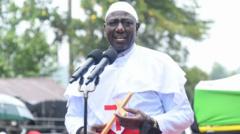
Article Text: William Ruto, who became Kenya’s president two years ago riding on the crest of the Christian vote, has been visibly shaken to find that over the last few months church leaders of all creeds are losing faith in him - seeing him less as a saviour and more as the greedy biblical tax collector. In the run-up to his victory, some of his most ardent evangelical supporters had dubbed him "David", after the shepherd boy in the Bible who rose to become king. The opposition had baptised him "deputy Jesus", accusing him of using Christianity to gain political capital as he attended church services from Catholic masses to the gatherings of obscure sects. He would wear the appropriate religious attire for each setting, sometimes knelt in supplication and on occasion was moved to tears by sermons. Afterwards, he credited God for his electoral success, and continued this practice of criss-crossing the country to attend a different church each Sunday. But following massive opposition to the tax hikes imposed by his government, the 57-year-old gained a new nickname: "Zakayo" - which is Swahili for Zacchaeus, the wealthy and unpopular Jericho tax collector featured in the Bible. The president has always maintained that if people want better public services and a reduction in the country’s debt burden, they have to pay up. Over the last two years, taxes on salaries have gone up, the sales tax on fuel has doubled and people are also paying a new housing levy and a health insurance tax that is yet to benefit many Kenyans. When momentous anti-tax protests erupted in June, the young people who led them, popularly referred to as Gen Zs, also called out churches for being too close to politicians and allowing them to preach from their pulpits. Their anger forced the government to retract a controversial finance bill that had included more tax increases - and it woke up the churches, whose clergy began to openly criticise Ruto and his policies. This too was a momentous development as the faith economy is big business in a country where more than 80% of the population are Christian - and a fundraiser with the right politician can greatly improve the fortunes of a church. Last month, Teresia Wairimu, founder of Faith Evangelistic Ministries (Fem), a church in the capital, Nairobi, where Ruto and his family have frequently worshipped, suggested their King David was heading back to the field where sheep grazed. "As a voter, I’m embarrassed," she said in her sermon. Another sermon by Rev Tony Kiama of the River of God Church recently went viral after he called out Ruto’s government for "not serving God’s purpose but an evil one", citing the killings during the recent protests, the rising cost of living and every-day corruption. The most hard-hitting criticism came from the Catholic bishops, who accused Ruto’s government of perpetuating a "culture of lies," highlighting unfulfilled campaign promises. One bishop dubbed Kenya an "Orwellian dystopian authoritarian" state, where dissent was met “with intimidation, abduction or even assassination". This was a pointed reference to the 60 people who died and the 1,300 others arrested during the anti-tax demonstrations. A further 74 people have been abducted and 26 reported missing in the last five months, according to the state-run Kenya National Commission on Human Rights. The Catholic Church’s influence in Kenya extends beyond its congregation due to its wide investment in education, healthcare and other social programmes. It has also been angered by the chaotic transition to a new social health insurance scheme, with the government owing millions of dollars to faith-based hospitals. The bishops’ outspoken assessment of the state of the nation has reminded Kenyans of the role church leaders played when they pushed for a return to multi-party democracy in the 1990s. But analysts say under Moi’s successors - Mwai Kibaki and Uhuru Kenyatta, both Catholics - clerics lost their voice. "Under President William Ruto, things got even worse," veteran journalist Macharia Gaitho wrote, suggesting "churches were bribed into silence." The Catholic bishops’ stance has found support from other denominations and Muslim clerics - despite Ruto's earlier backing from religious leaders due to his conservative views. Meanwhile, Ruto and his allies initially hit back, accusing the bishops of misinformation. However, analysts warn that the president, who often relies on scripture to respond to detractors, should tread carefully to avoid a backlash, particularly as dissent might jeopardize his chances for re-election. Previously unwavering allies are now expressing their criticism of his administration and the consequences of his policies. A close ally, MP Oscar Sudi, recently apologised to the bishops on behalf of the government. Ruto himself appears to soften his response to the criticism, indicating his willingness to engage with the churches moving forward. As he acknowledges the limitations in his administration, Ruto must reconcile his past alliance with the church to navigate the growing dissent he now faces. His current predicament reflects an unsettling truth: the institutions that initially supported him could also play a pivotal role in his political downfall come the next election.

