In brief
As President Yoon Suk Yeol faces impeachment, his supporters—fueled by a mix of historical fears and unsubstantiated conspiracy theories—believe that an opposition victory could lead to a communist takeover. The president's rhetoric has resonated particularly with younger generations, despite a lack of direct experience with North Korean threats, reinforcing deep-seated anti-communist sentiments in South Korea.
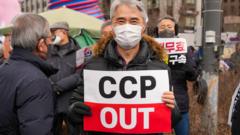
In a crisp January afternoon setting outside South Korea's Constitutional Court, pharmacy student Shin Jeong-min, accompanied by a compliant crowd, exhibited fervent support for the impeached president, Yoon Suk Yeol. Chanters proclaimed, "Release him now. Cancel his impeachment." Many among them cite ominous theories, rooted in historical fears, suggesting the left-wing opposition seeks to unify with North Korea and impose a communist regime. While these voices persist, they are largely drawn from the aging population who endured the Cold War and its aftershocks, having lived through North Korea's 1950s invasion. Yoon's authority, previously challenged by his push for martial law, has perpetuated a wave of anti-communist fervor, leading supporters to believe that a shift in power could endanger their democratic society. "This is a war between communism and democracy," stated a determined office worker, suggesting an existential threat. With Yoon having leveraged fears of alleged North Korean infiltration to advocate for his controversial power grab, a mix of historical trauma and emerging conspiracies has galvanized a diverse base of support across age groups.Though anti-communism has historically served as a governance tool for South Korea's military dictators, sociological experts note that contemporary threats differ; North Korea's nuclear capabilities and technological advances present greater risks than infiltration. The narrative of an immanent leftist coup, however, has taken flight, reshaping public sentiment and blurring political lines, as many young South Koreans converted skepticism into belief in Yoon's urgent claims.Clear sentiments emerge during pro-Yoon demonstrations, where supporters assert that North Korea's actions and affiliations with China necessitate extreme measures. However, critics of Yoon, such as opposition lawmakers, argue that such allegations merely mimic past authoritarian tactics. They decry these methods as distractions from democratic obligations, pointing out that acts of contrived manipulation could undermine the foundation of fair elections.Polling reveals a tenuous shift in attitudes towards Yoon, despite an overall preference for his removal from office. Meanwhile, mounting distrust targeting China intertwines with existing fears of the North, highlighting a growing narrative among the South's populace that sees foreign influence as potentially subverting national autonomy. With debates intensifying over the meaning of freedom, democracy, and external threats, some fear that the emergence of conspiracy theories under Yoon's presidency could symbolize a relentless battle within society for the future path of the nation. As discussions continue on how best to navigate relationships with North Korea and China, observers note the risks that polarizing political identities may pose for South Korea's social fabric.