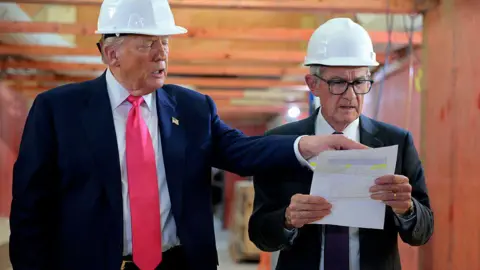
The leaders of the Democratic Republic of Congo and Rwanda are set to sign a peace deal aimed at ending the long-running conflict in the region at a summit hosted by US President Donald Trump in Washington.
Ahead of the summit, there has been an escalation in fighting in resource-rich eastern DR Congo between government forces and rebels believed to be backed by Rwanda. DR Congo's army accused its rivals of attempting to sabotage the peace process, but the M23 rebels said the army had launched an offensive in breach of a ceasefire.
At the start of the year, the M23 seized large parts of eastern DR Congo in an offensive that saw thousands killed and many more forced from their homes.
DR Congo's President Felix Tshisekedi and his Rwandan counterpart Paul Kagame have frequently exchanged insults in recent years, with each side blaming the other for igniting the conflict. Trump managed to get the two countries' foreign ministers to sign a preliminary peace accord in June, which he hailed as a glorious triumph.
Tshisekedi and Kagame will now endorse it, with several other African and Arab leaders expected to attend the signing ceremony. The M23 will not be present as it is engaged in a separate peace process led by Qatar.
The Trump administration is pushing to resolve these relations to facilitate US investments in the mineral-rich region, vital for electronics and military hardware. Rwanda denies supporting the M23, despite UN accusations of its army's involvement.
While the signing ceremony is a hopeful gesture, experts remain pessimistic about its efficacy given the ongoing violence and lack of a ceasefire. Previous peace deals have faltered under similar circumstances, leading many to doubt whether this latest effort can bring about real change in a conflict that has persisted for decades.
Ahead of the summit, there has been an escalation in fighting in resource-rich eastern DR Congo between government forces and rebels believed to be backed by Rwanda. DR Congo's army accused its rivals of attempting to sabotage the peace process, but the M23 rebels said the army had launched an offensive in breach of a ceasefire.
At the start of the year, the M23 seized large parts of eastern DR Congo in an offensive that saw thousands killed and many more forced from their homes.
DR Congo's President Felix Tshisekedi and his Rwandan counterpart Paul Kagame have frequently exchanged insults in recent years, with each side blaming the other for igniting the conflict. Trump managed to get the two countries' foreign ministers to sign a preliminary peace accord in June, which he hailed as a glorious triumph.
Tshisekedi and Kagame will now endorse it, with several other African and Arab leaders expected to attend the signing ceremony. The M23 will not be present as it is engaged in a separate peace process led by Qatar.
The Trump administration is pushing to resolve these relations to facilitate US investments in the mineral-rich region, vital for electronics and military hardware. Rwanda denies supporting the M23, despite UN accusations of its army's involvement.
While the signing ceremony is a hopeful gesture, experts remain pessimistic about its efficacy given the ongoing violence and lack of a ceasefire. Previous peace deals have faltered under similar circumstances, leading many to doubt whether this latest effort can bring about real change in a conflict that has persisted for decades.