
In brief
Former President Donald Trump's recent remarks regarding Ukraine's role in the ongoing war with Russia have drawn significant attention and criticism. Fact-checking efforts reveal discrepancies in his claims about President Zelensky's leadership and popularity, underscoring the complexities surrounding the conflict and election dynamics in Ukraine.
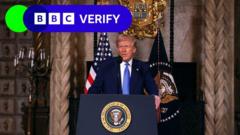
In a recent press interaction from his Mar-a-Lago estate in Florida, former President Donald Trump cast blame on Ukraine for its ongoing conflict with Russia, making a series of controversial statements about President Volodymyr Zelensky. These claims, which some analysts say reflect prevalent Russian propaganda, emerged as U.S. and Russian officials began discussions in Riyadh aimed at ending nearly three years of warfare. In response to Trump's assertions, Zelensky accused him of existing in a "disinformation space" created by the Kremlin.Trump's remarks included labeling Zelensky as a "dictator without elections." While it is true that Ukraine has not held presidential elections since Zelensky's initial victory in 2019, the inability to conduct elections stems from martial law instituted following Russia's invasion in February 2022. This martial law—established after the annexation of Crimea in 2014—prohibits elections during periods of conflict. Observers noted that Zelensky's election in 2019, where he secured a decisive 73%, was deemed competitive and legitimate.Trump further claimed that Zelensky's approval rating had plummeted to a mere 4%, a statistic that lacks credible sourcing. Polling efforts are hampered by the war's impact on the population, yet some surveys indicate a significant majority still express trust in Zelensky, albeit with a noted decline from previous high levels of support.In critiquing the conduct of peace talks in Riyadh that excluded Ukraine, Trump stated, "You should have never started it," echoing rhetoric used by the Kremlin that attributes the war's inception to Ukraine. However, historical context reveals that Russia initiated a full-scale invasion of Ukraine in February 2022, following years of escalated tensions and prior incursions that began in 2014.The commentary surrounding Trump's statements continues to evolve as the situation in Ukraine remains precarious, with ongoing military operations and a population grappling with displacement and conflict—factors that complicate both leadership legitimacy and the prospect of free elections in the current environment.
