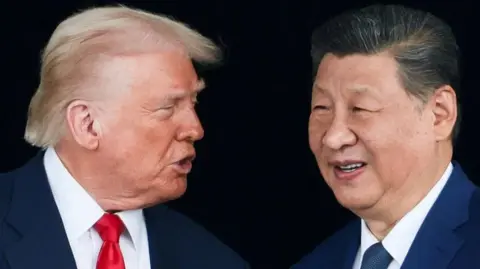
Donald Trump recently engaged in a heated discussion with South African President Cyril Ramaphosa at the White House, centering on contentious claims about violence against white farmers in South Africa. The seemingly cordial meeting turned combative as Trump presented videos and documents alleging persecution of South Africa's white minority.
Initially, Trump played a video featuring opposition politicians inciting violence against white farmers, alongside footage of rows of white crosses. He claimed these crosses marked burial sites for murdered farmers, asserting, "These are burial sites right here. Burial sites. Over a thousand of white farmers." However, the crosses were actually a temporary memorial for a couple who had been murdered in 2020, according to Rob Hoatson, an organizer at the protest where the crosses were erected.
Trump's depiction of a "white genocide" in South Africa has been a recurring theme throughout his political career. He claimed many South Africans feel persecuted, leading them to seek asylum in the U.S. While South Africa has a high overall murder rate, official statistics show that among last year's murders, only 44 involved the farming community, casting doubt on Trump's assertions of widespread violence specifically against white farmers. A dismissal of claims regarding genocide by a South African judge further weakens his position.
During the meeting, Trump alleged South African officials publicly called for violence against white farmers by showcasing footage of the song "Kill the Boer," a politically charged anti-apartheid anthem. Critics have labeled it hate speech, yet South African courts have deemed it acceptable in political contexts. Ramaphosa clarified that the Economic Freedom Fighters (EFF), which has a minor role in the political landscape, does not reflect the broader government stance.
Additionally, Trump presented articles as evidence of the alleged killings, but one photo he circulated was later revealed to be unrelated, depicting violence within the Democratic Republic of Congo rather than South Africa.
In the exchange, while Trump leaned on provocative claims, Ramaphosa maintained a calm demeanor, addressing the inaccuracies and emphasizing the government's true policies regarding agriculture and security.