
In brief
The discovery provides insight into the life 50,000 years ago and highlights the impact of climate change on permafrost regions.
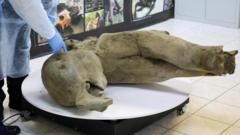
In a remarkable discovery, Russian scientists have unveiled the remains of a 50,000-year-old baby mammoth, named "Yana," found in the thawing permafrost of the Yakutia region, Siberia. This almost perfectly preserved carcass, weighing over 100 kg and measuring 120 cm tall and 200 cm long, is believed to be the most well-preserved mammoth ever found. At the time of her death, Yana was estimated to be around one year old.The discovery occurred in the Batagaika crater, the largest permafrost crater globally, during summer months by local residents who stumbled upon the almost entirely thawed remains. As Maxim Cherpasov, the head of the Lazarev Mammoth Museum Laboratory, noted, the local inhabitants were fortunate to be in the right place at the right time. They even created a makeshift stretcher to transport the mammoth from its resting place.Typically in such finds, parts of the mammoth's body, particularly the trunk, are often consumed by modern predators or birds as they thaw out. However, the head of Yana remains largely intact. Gavril Novgorodov, a researcher at the museum, speculated that the mammoth probably became trapped in a swamp, allowing it to be preserved in this condition for thousands of years. The remains are currently being examined at North-Eastern Federal University in Yakutsk, with scientists working to pinpoint the exact time of death.Yana's discovery is part of a broader trend as Russia's permafrost, increasingly affected by climate change, reveals more prehistoric creatures buried for millennia. Recent findings in the area include a 32,000-year-old mummified body of a saber-tooth cat and the remains of a 44,000-year-old wolf, showcasing the rich archaeological potential that lies beneath the thawing ground.
