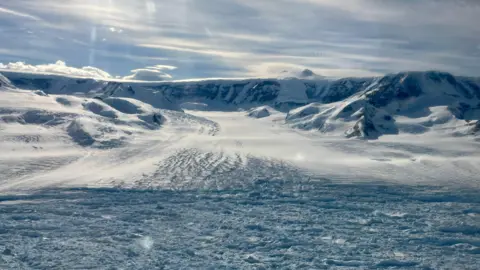
The Hektoria Glacier in Antarctica has entered a phase of swift retreat, igniting discussions and debates among scientists regarding the underlying causes and potential consequences for global sea levels.
Notably, this glacier retreated over 8 kilometers (5 miles) in a mere two-month span during late 2022, according to recent research. The authors of the study propose that this could mark Hektoria as the first modern glacier showing a rapid destabilization process as it rests on the seabed.
Such a scenario could herald faster sea-level rises in other Antarctic regions, increasing stakes in the climate change dialogue. However, dissenting views exist among scientists who argue that part of the glacier was likely floating, making the observed changes less extraordinary.
Significant alterations in the glacier are difficult to contest, with data indicating a retreat of approximately 25 kilometers (16 miles) from January 2022 to March 2023. Yet, the investigation resembles a 'whodunnit' mystery, as emphasized by lead author Naomi Ochwat of the University of Colorado Boulder.
Concerns regarding Hektoria began with the collapse of the Larsen B ice shelf in 2002 that had previously held back the glacier. This event set the stage for accelerated movement and thinning of Hektoria, culminating in recent accelerated losses.
While ice calving and glacier dynamics can be natural processes, researchers note that the rapid retreat recorded in late 2022 was exceptional. The new study claims that during this period, the glacier front was grounded, potentially leading to unprecedented speed in ice loss.
Speculations abound about the implications of this finding. If the process observed at Hektoria were to occur in other parts of Antarctica, it could significantly heighten the rate of sea-level rise, with potential impacts observed at glaciers like the infamous Thwaites Glacier, known for its ice mass capable of contributing immensely to global sea levels.
Nonetheless, skepticism remains within the scientific community around certain findings of the study, particularly concerning the glacier's grounding line. The uncertainty surrounding its position is seen as pivotal in determining the characterization of Hektoria’s recent behavior.
Despite differences of opinion regarding the specific mechanics driving Hektoria’s changes, there is unanimous concern regarding the fragility of the Antarctic region in the face of accelerating climate change. Call for improved satellite monitoring is essential for understanding these shifts and their broader implications for our planet’s future.